People visit Kumbakonam for spiritual temple visit, but performing ancestral rituals(Tharpanam) on Amavasya or Amavasai day at Mahamaham Tank is a major one. You have to plan around lunar dates, find the right priest, and know the local procedures.
Note: Finding the right priest or புரோகிதர் will be a difficult task.
Here is how to actually get it done.
Quick Facts
- Ritual: Pitru Tharpanam offerings for diseased family members or ancestors
- Place: Mahamaham Tank, Kumbakonam, Thanjavur, Tamil Nadu
- Best days to perform: Preferably Thai Amavasai (Jan/Feb), Aadi Amavasai (Jul/Aug), and Mahalaya Amavasya (Sep/Oct)
- Ritual Cost: Between ₹500 to ₹8,000 for a priest, depending on the ritual.
What is Amavasya or Amavasai Day?
Amavasya aka Amavasai is the new moon day in the Hindu lunar calendar. In simple words on the particular day there won’t be a moon appearing at night time. Since the sun and moon align on this day, Hindu tradition treats it as the most powerful time to perform Pitru Tharpanam—rituals to thank and seek blessings from your ancestors.
Some families do this every month. But in Tamil Nadu, the notable dates are:
- Thai Amavasai (January/February)
- Aadi Amavasai (July/August)
- Mahalaya Amavasya (September/October)
Personal Note:
On this particular day many of them will offer Agathi Keerai to cows. In our own family circle, ancestors are remembered with their photo and a traditional meal of poosanikai sambar, rasam, vadai and payasam is offered to them.
It is a simple, heartfelt tradition to honour and remember loved ones.
Amavasya Dos and Don’ts
| Do | Don’t |
|---|---|
| Offer Tarpanam to ancestors. | Avoid starting major new work. |
| Donate food, clothes, or grains. | Avoid washing clothes and cutting hair or nails. |
| Worship Lord Shiva and light a lamp. | Avoid non-vegetarian food and alcohol. |
| Eat simple vegetarian food. | Avoid arguments and anger. |
| Spend time in prayer or meditation. | Avoid unnecessary late-night travel. |
Why Mahamaham Tank?
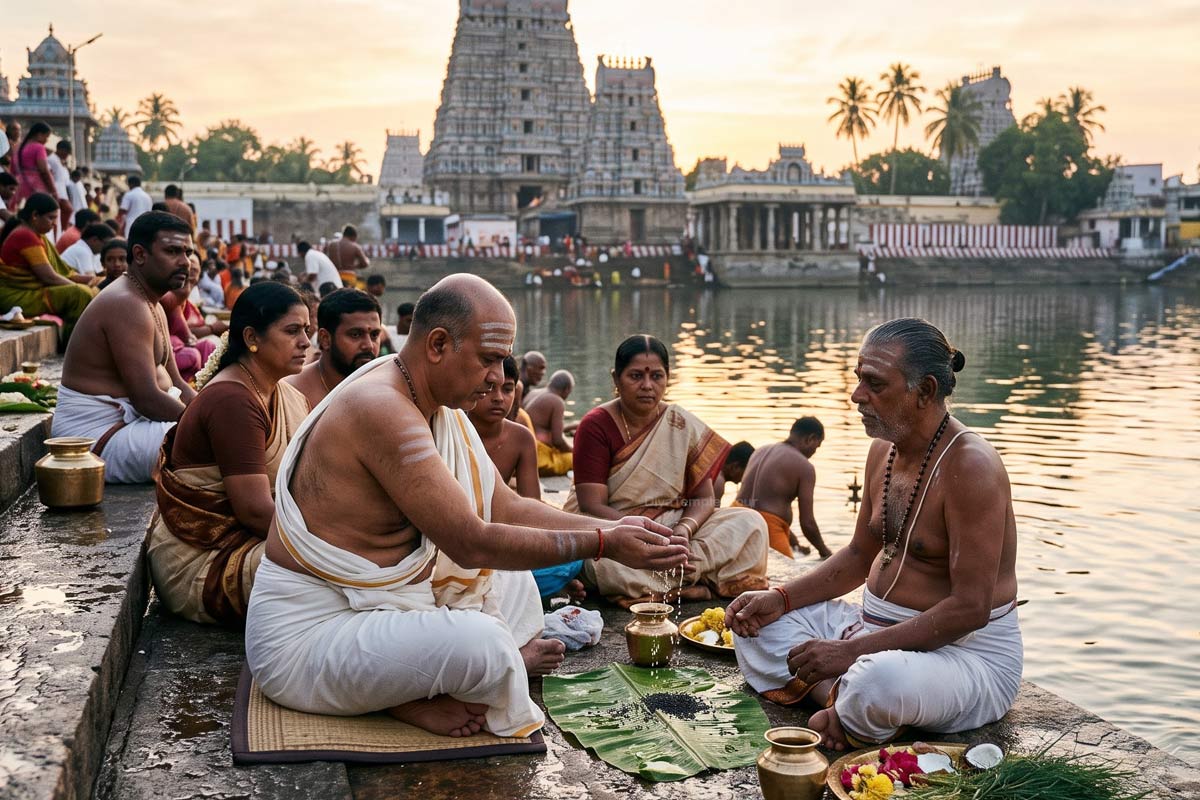
Mahamaham Tank located right in the center of Kumbakonam town which is famous like Kumbh Mela. It’s a 6.2-acre tank surrounded by pavilions and shrines, holding 20 distinct holy wells (theerthams) named after rivers and deities. It’s famous for the massive Mahamaham festival every 12 years, but locally, it’s the daily hub for ancestral rites in the Cauvery delta. People do their offerings on the banks, then take a dip in the water.
Note to remember:
Previously the tank was opened for visitors to have a holy bath in this sacred water. But due to misuse of the water they closed it. If you want to explore the tank please visit on February 7 to February 16, 2028 during the Mahamagam festival.
What is Pitru Tharpanam
Pitru: Refers to our ancestors or forefathers
Tarpanam: Offering water mixed with black sesame seeds to ancestors using the thumb.
Pitru Dosham: A belief that neglected ancestral rites, disrespect to elders, or certain planetary positions may affect a person’s horoscope.
Shraddha: Offering food and water to honor deceased ancestors.
Pitru tharpanam is the actual ritual offering to your ancestors. A priest guides you through the mantras while you make offerings using three main items:
- Black sesame seeds (Til): For spiritual purity.
- Water: To represent life and wash away sins.
- Darbha grass (Kusha): Used as a seat and woven into a ring (pavitram) you wear during the rite.
The point is to offer spiritual offerings to diseased family members.
How the ritual works at mahamaham tank
Here is what actually happens on the ground:
- Meet at the banks: You’ll meet your priest at one area around the tank.
- Sankalpam: The priest asks for your family’s Gotra (lineage) and the names of up to three generations of ancestors to start the prayer.
- The offering: Wearing traditional clothes (usually a dhoti without a shirt for men), you offer water and sesame seeds over the darbha grass.
- The sacred bath: Afterward, you walk down the steps into the tank for a holy dip to wash away the ritual items. (Steps are slippery so careful)
- Temple visit: Families usually change into dry clothes and visit the nearby Kasi Viswanathar temple or Abhi Mukheswarar Temple.
What to bring for the ritual
Some priests provide everything for a flat fee. Others expect you to bring the supplies. Always ask when you book. A standard kit includes:
- Black sesame seeds (50-100 grams)
- Raw rice
- Darbha grass
- Betel leaves and nuts
- Bananas or local fruits
- A copper or brass vessel (Panchapatra) for water
- Dry clothes and a towel
- Cash for tips and temple offerings
Mahamaham Tank vs. Rameswaram
People often get confused whether to go to Kumbakonam or Rameswaram for these ritual. Both places are highly respected, but the purposes are different.
| Feature | Mahamaham Tank (Kumbakonam) | Agni Theertham (Rameswaram) |
|---|---|---|
| Location | Central Tamil Nadu (Cauvery Delta) | Pamban Island (Coastal) |
| Water Source | Enclosed temple tank | Open ocean (Bay of Bengal) |
| Temple Proximity | Surrounded by Navagraha temples and 100+ ancient temples | Anchored entirely by the Ramanathaswamy Temple |
| Trip Style | Best for combining rites with a multi-temple road trip | Best for a dedicated pilgrimage to a single holy site |
Temples to Visit After the Pithru Tharpanam
The best part about doing Tharpanam in Kumbakonam is the location. Once you finish at the tank, you can visit surrounding temples on the same trip. Popular stops include the Adi Kumbeswarar Temple, the Sarangapani Temple, and the Navagraha Temples.
Practical note: Don’t try to cover six temples in the same day. The ritual requires fasting until it’s done, and you will feel tired and exhausted. Plan to visit two or three nearby temples.
Practical Planning Advice
Book early for major dates. On a regular Amavasya, you can easily find a priest at the tank. But for Mahalaya Amavasya or Thai Amavasai, book weeks in advance. The place get over crowded, and wait times drag on for hours. Even weather also very hot.
Check the timing. Amavasya follows lunar phases. The exact timing (Tithi) might start Tuesday afternoon and end Wednesday morning. Check a local panchangam or ask an astrologer so you don’t miss the window.
Book rooms close to the tank. Kumbakonam has great hotels, but they sell out fast on Amavasya weekends. Staying close to the tank helps, especially if elderly family members need to rest after the bath.
Common Questions and Answers
Do I need my own family priest?
No. Dozens of local priests (prohits) available at Mahamaham Tank and can guide you.
How much does it cost?
A standard monthly Amavasya rite runs ₹500 to ₹4000. Mahalaya Amavasya cost ₹1500 to ₹8000, which usually includes materials required for the rituals.
Can elderly family members do this?
Yes, the pavilions have shaded seating. Just watch their step on the wet stairs leading into the tank because it will be more slippery.
What time of day is best?
Traditionally, you do Tharpanam between sunrise and 10:00 AM, before eating. But again, it all depends on the exact Amavasya Tithi that day.
Which god was born on Amavasya?
Lord Shani was born on Amavasya and his birthday is popularly known as Shani Jayanti.
Can ladies perform Tarpanam?
Yes, both men and women can do tarpanam. Even your parents are alive you can do for ancestors to get blessing from the ancestors and Lord Yama.